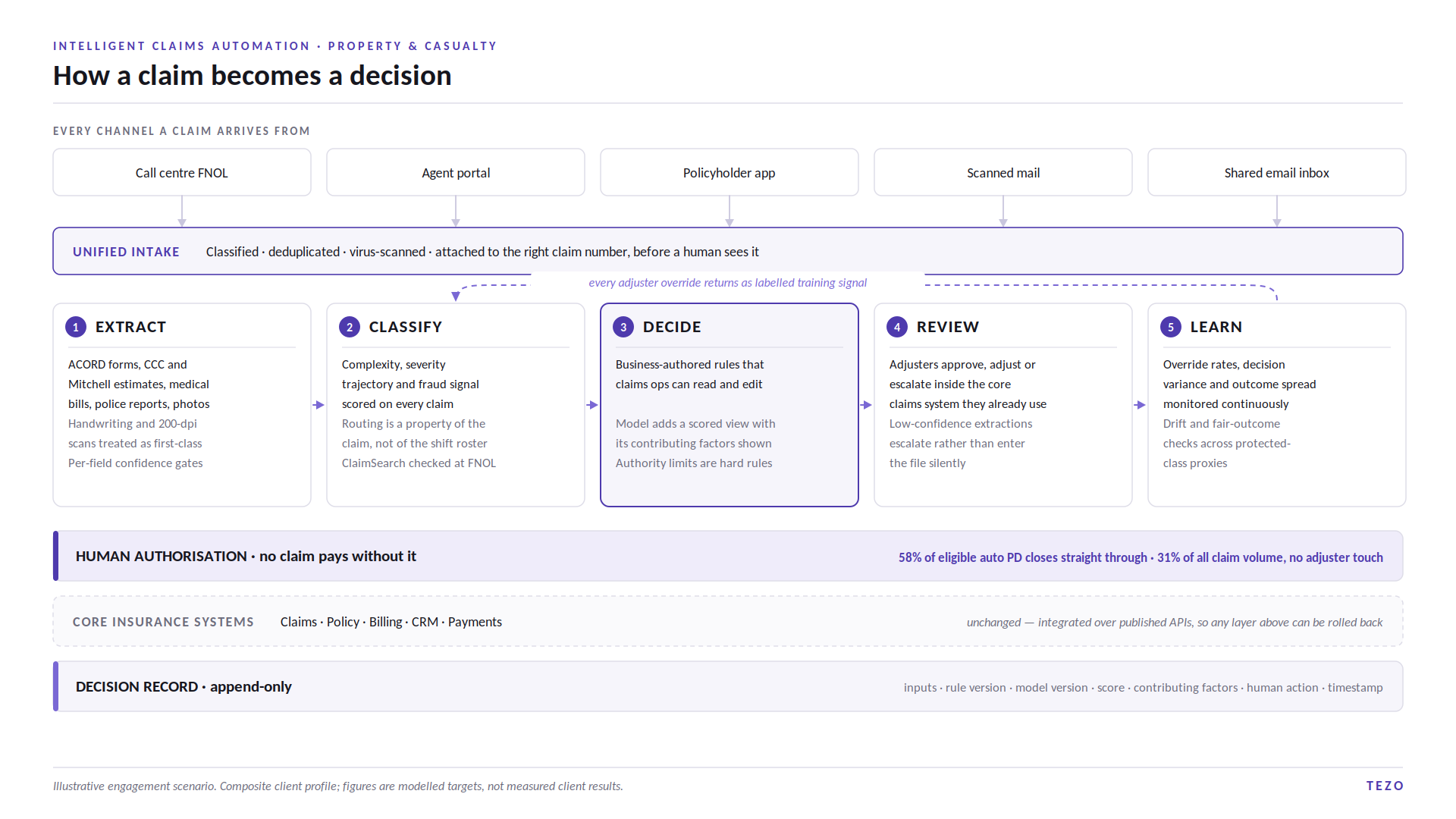
Claims that decide themselves. Adjusters free for the ones that can’t.

A mid-market P&C carrier was losing its best examiners to routine files it never needed them for. Working with Tezo, it rebuilt claims intake and decisioning so straightforward losses now close on their own, and complex ones reach an adjuster with the file already assembled.

Talk to us
A carrier whose growth had outpaced its claims operation.
A mid-market property and casualty carrier writing personal auto, homeowners and small commercial across 11 US states, with around $600M in direct written premium and 240,000 claims a year. Its 180 adjusters and examiners worked across two service centres on a mainstream core platform, while loss notices arrived through a call centre, an agent portal, an app, scanned mail and a shared inbox. Nothing in claims had been automated before.
CHALLENGES
Every claim arrived as a pile, not a file
Loss notices came through five channels and left the same way: emailed ACORD forms, estimates in two vendor formats, medical bills, phone photos, police reports scanned at 200 dpi. An examiner spent the first half-hour of every claim reconstructing it, and nothing was queryable until someone had typed it in.
The same claim got different answers
Two adjusters looking at comparable property-damage losses reached materially different reserve and settlement positions, depending on caseload, tenure and the day of the week. The file recorded what had been decided and never the reasoning behind it, which is a fair-claims-practice exposure as much as an economic one.
Expertise was spent where none was needed
A $1,400 windshield claim and a $140,000 bodily-injury claim entered the same queue and competed for the same reviewer. The carrier’s most experienced examiners spent roughly 40% of the week on files requiring no judgement at all, while the files that genuinely needed them waited in line behind those.
Fraud signals surfaced too late to matter
Suspicious patterns were caught at reserve review or at the point of payment, weeks after both the money and the goodwill had already moved. SIU received a high volume of undifferentiated referrals with no way to rank one against another, so genuine cases sat in the same pile as the noise around them.
The evidence did not exist when regulators asked
Market-conduct exam responses and DOI complaint replies meant reconstructing the decision rationale for a claim from free-text adjuster notes. A single exam response consumed weeks of manual file pulls, and the answer was only ever as good as whatever somebody had thought to write down at the time it was handled.
WHAT WE DID
#
1
Measured the book before building anything
The first six weeks produced no software. One quarter of closed claims was instrumented and segmented by document mix, severity, channel and touch count, to establish which claims were straight-through eligible and which never would be. About a third qualified, lower than the executive expectation and higher than the adjusters’. Nothing was trained until claims leadership signed it off.
#
2
Gave five channels one front door
Email, portal uploads, agent submissions, mobile photos and scanned mail were routed into a single intake service that classified, deduplicated, scanned and attached every artefact to the correct claim number before a human saw it. The shared inbox stayed open for six months as a fallback, then closed on evidence that nothing was falling through, rather than on a date.
#
3
Read every document once, and permanently
Extraction models were trained on the carrier’s actual document set rather than a generic corpus: ACORD loss notices, CCC and Mitchell estimates, medical bills, police reports and handwritten statements. Confidence thresholds were tuned field by field, so a low-confidence value escalated to a person instead of quietly entering the claim file and being trusted downstream.
#
4
Made triage a property of the claim, not the roster
Every structured claim is now scored on complexity, severity trajectory and fraud signal, with an ISO ClaimSearch check at first notice rather than at reserve review. Routing stopped depending on who was on shift. A claim of a given profile goes to the same queue at the same priority every time, and claims operations can see and change that behaviour without a release.
#
5
Put the rules in the business’s hands
Settlement recommendations for straightforward claims come from a decision layer where claims operations author and edit the rules themselves, in a format they can read. The model contributes a scored view with its top contributing factors exposed alongside it. Payment authority limits are enforced as hard rules, never as model outputs, so nothing can recommend past its authority.
#
6
Kept a person on every decision that pays
Adjusters approve, adjust or escalate inside the core claims system they already use, and no claim pays without a human authorisation event. Every override is captured as labelled signal and fed back, which is why accuracy improves rather than plateaus. Each automated decision writes an append-only record: inputs, rule and model version, score, factors, human action, timestamp.
BUSINESS OUTCOMES
The queue now sorts itself
Adjusters open the file that actually needed them. Roughly 19% of claims-handling hours moved from routine processing back to complex work, without a change in headcount.
An exam response became a query, not a project
Every automated decision carries its own evidence, so answering a market-conduct request or a DOI complaint starts from a record rather than from a reconstruction.
No items found.
Tech Stack
Azure
Azure OpenAI
Elevate your claims experience. Explore the possibilities of automated claims with our expert team.
Book a Strategy Session
arrow right